Zrika Bodycare | Natural Skincare Insights
A customer once told us something that stopped us in our tracks: “I have a 300 dollars skincare routine. My skin looks okay. But I’m still anxious, stressed, and exhausted. What’s the point?”
She wasn’t alone. According to a 2023 survey by the American Psychological Association, 77% of adults report experiencing stress that affects their physical health—including their skin. Yet most skincare routines completely ignore the mental wellness component.
Here’s the uncomfortable truth: You can have perfect skin and still feel terrible. Because skincare and mental wellness aren’t separate concerns—they’re intrinsically connected through your nervous system, hormones, and daily rituals.
At Zrika Bodycare, we’ve spent years understanding this connection. Not just formulating products that work on skin, but creating experiences that actually calm your mind while caring for your body.
Here are 7 ways to transform your skincare routine from another task you “should” do into something that genuinely nourishes both your skin and your mental state.
The Problem: Skincare Became Performative, Not Restorative
When did your skincare routine stop feeling good?
Maybe when you started scrolling Instagram seeing 12-step regimens. Maybe when “self-care” became another thing to optimize and perfect. Maybe when products promised transformation but only delivered more stress about whether you’re “doing it right.”
The research is clear: A 2022 study in Journal of Health Psychology found that self-care activities perceived as obligatory (rather than chosen) increased stress instead of reducing it. When your skincare feels like homework, it’s not actually caring for you.
The Mind-Skin Axis Is Real Science
Your skin and brain develop from the same embryonic tissue. They remain connected throughout life through what scientists call the “brain-skin axis”—a bidirectional communication network involving:
- Nervous system: Stress triggers cortisol → inflammation → breakouts, sensitivity, accelerated aging
- Immune system: Chronic stress impairs skin barrier → increased reactivity
- Hormones: Stress hormones disrupt oil production, healing, and regeneration
- Neurotransmitters: Your skin produces serotonin, dopamine, and endorphins
Research in Experimental Dermatology (2021) found that psychological stress directly impairs skin barrier function within 24 hours. Conversely, tactile self-care (gentle touch during skincare) reduces cortisol and increases oxytocin.
Translation: Skincare and mental wellness aren’t just connected—they’re inseparable. Treating one without the other misses half the picture.
7 Ways to Make Skincare Actually Support Your Mental Health
1. Transform Cleansing Into Conscious Breathing Practice
Most people hold their breath or breathe shallowly during skincare. This signals stress to your nervous system.
Try this instead: The 4-4-8 Cleansing Breath
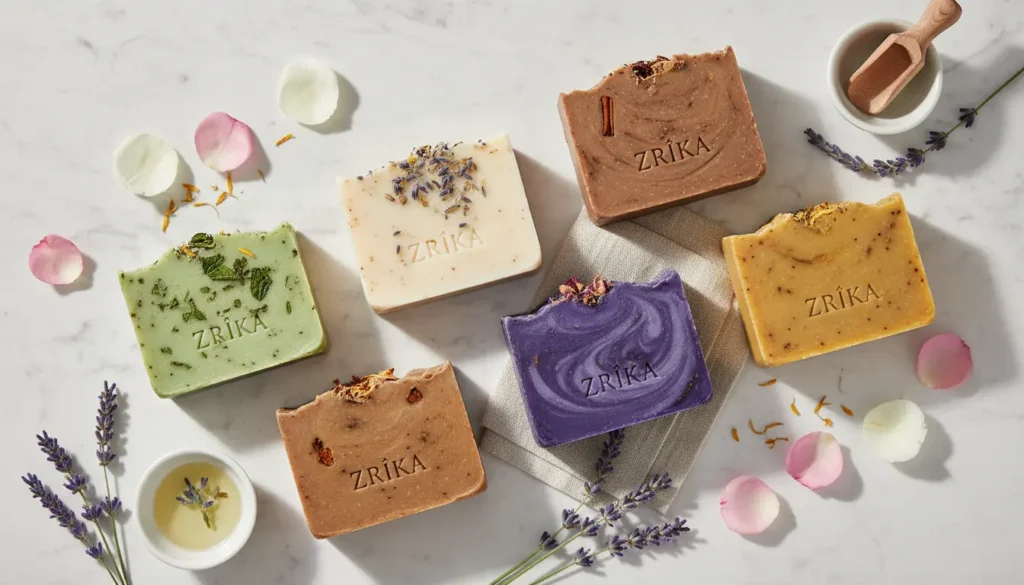
As you wet your face and apply luxury natural soaps for daily self-care:
- Breathe in for 4 counts through your nose
- Hold for 4 counts
- Exhale for 8 counts through your mouth
Repeat 3-5 times while gently cleansing. The extended exhale activates your parasympathetic nervous system (rest-and-digest mode).
Why this works: Research in Frontiers in Psychology (2023) found that breath-focused activities during routine tasks significantly reduced anxiety markers and improved mood. You’re not adding another task—you’re transforming an existing one.
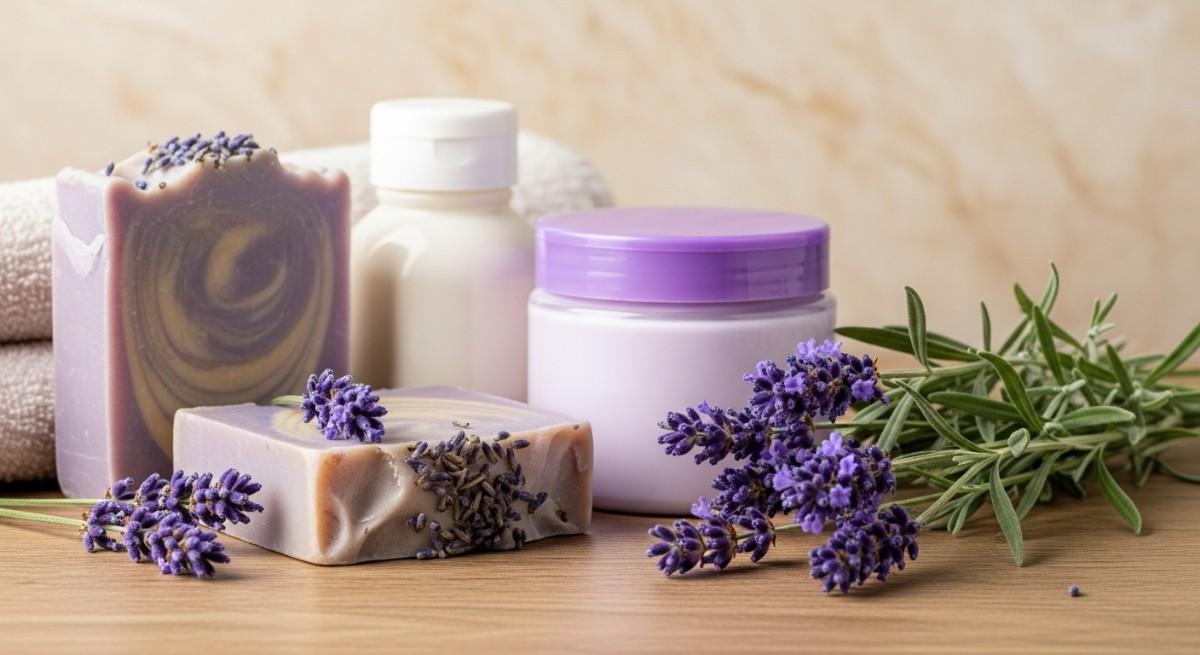
Practical tip: Use soap with calming essential oils like lavender or sandalwood. The scent enhances the calming effect through your olfactory system’s direct connection to your limbic brain (emotion center).
2. Make Moisturizing a Self-Compassion Practice
Applying body cream mechanically while mentally planning your day? You’re missing the entire point.
Try this: The Compassionate Touch Protocol
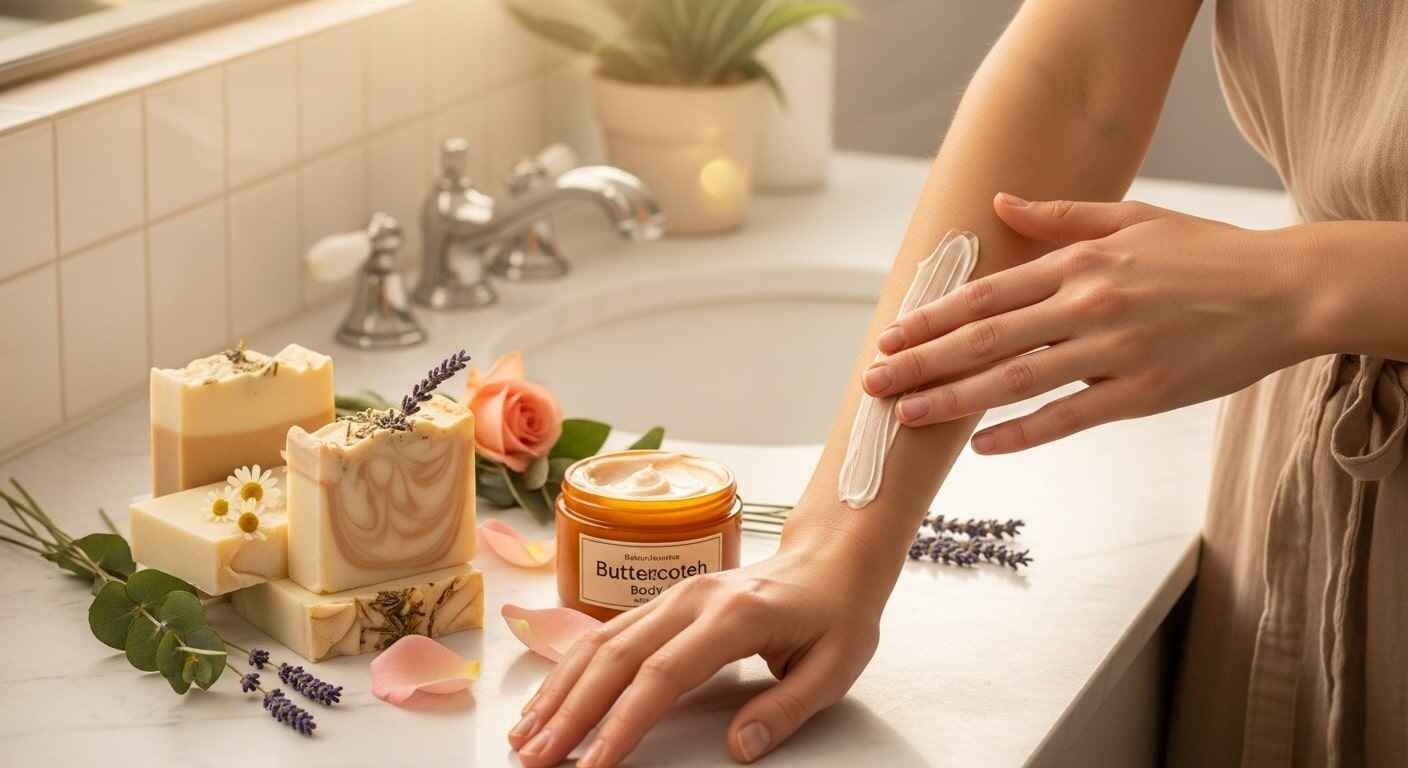
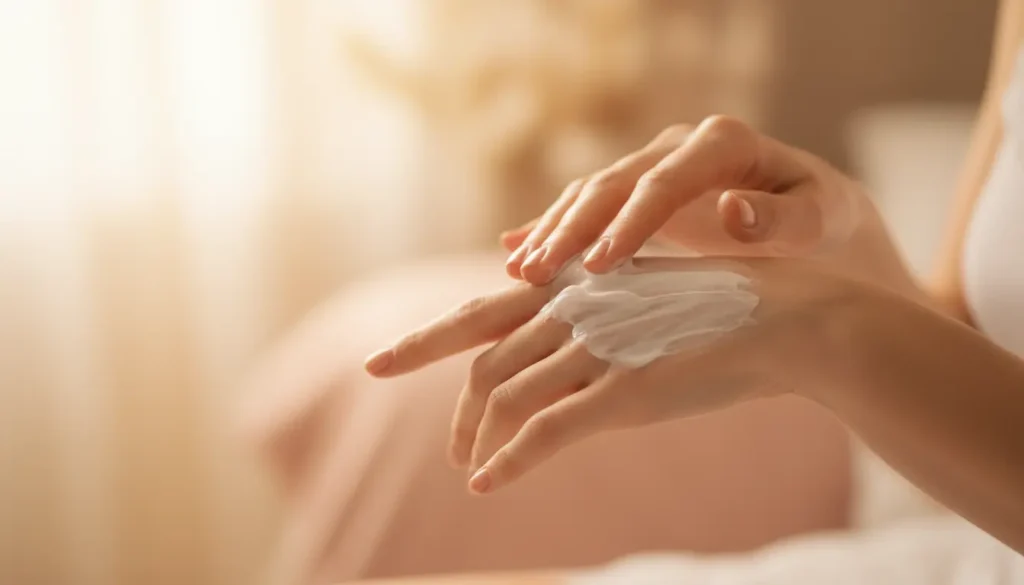
After showering, while applying body cream with natural ingredients for skincare:
Step 1: Warm cream between your palms. Take three deep breaths.
Step 2: Starting at your feet, apply with slow, deliberate strokes. As you touch each body part, internally acknowledge it: “Thank you, feet, for carrying me.” “Thank you, legs, for your strength.”
Step 3: Notice areas of tension, dryness, or discomfort. Give them extra attention—not with judgment, but with care.
Step 4: End at your heart center. Place both hands on your chest. Take three breaths, feeling your hands rise and fall.
The science: Self-compassion practices significantly reduce cortisol and increase oxytocin according to research in Psychoneuroendocrinology. Touch literally regulates your nervous system. You’re not just moisturizing—you’re calming your entire system.
This isn’t woo-woo. It’s using your body’s natural mechanisms for stress regulation through tactile stimulation.
3. Use Scent as a Mental State Trigger
Your olfactory system has direct neural pathways to your amygdala (emotion processor) and hippocampus (memory center). No other sense has this immediate access to your emotional brain.
How to leverage aromatherapy in daily skincare:
Morning routine: Use energizing scents (peppermint, citrus, rosemary) to promote alertness and positive mood. These increase dopamine and norepinephrine—motivation neurotransmitters.
Evening routine: Use calming scents (lavender, chamomile, sandalwood) to signal wind-down time. These increase GABA (your brain’s “calm down” neurotransmitter) and reduce cortisol.
Consistent pairing: Use the same scent for the same activity consistently. Within 2-3 weeks, your brain associates that scent with that mental state. Just smelling it begins shifting your mood before you even apply product.
Clinical evidence: A 2023 meta-analysis in International Journal of Neuroscience found that consistent aromatherapy during self-care activities reduced anxiety symptoms by 31% over 8 weeks.
At Zrika, we use real essential oils in luxury natural soaps for daily self-care—not synthetic fragrances. Your brain knows the difference at a neurological level, even if you don’t consciously notice.
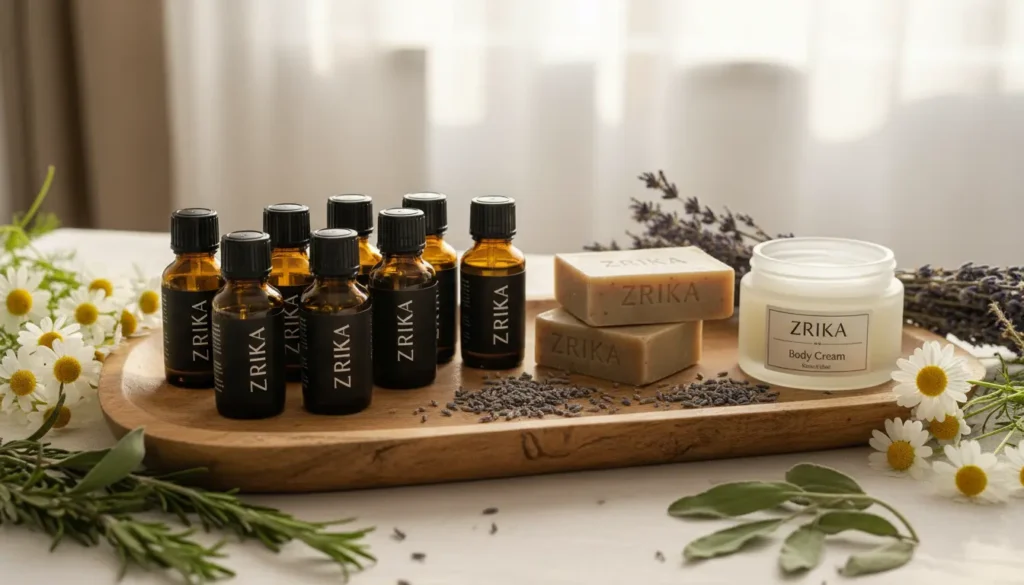
4. Create “Skin Stacking” for Compounded Calm
Layering compatible products isn’t just about skincare efficacy—it’s about creating extended mindfulness moments.
The 10-Minute Mind-Body Stack:
- Cleanse (3 min): Use herbal soap with conscious breathing
- Pause (1 min): Pat face/body dry slowly. Notice the softness of the towel.
- Apply (4 min): Body cream with compassionate touch technique
- Seal (2 min): If using facial oil or balm, apply with gentle upward strokes
Why this matters: Research shows that mindfulness practices need 5-10 minutes minimum to shift physiological stress markers. Shorter practices feel nice but don’t create lasting change. “Stacking” products extends your mindful moment naturally.
Practical pairing example:
- Neem or tea tree soap (purifying) + aloe-based cream (calming) = grounding routine for anxious mornings
- Rose or sandalwood soap (soothing) + shea butter cream (nourishing) = comforting routine for stressful evenings
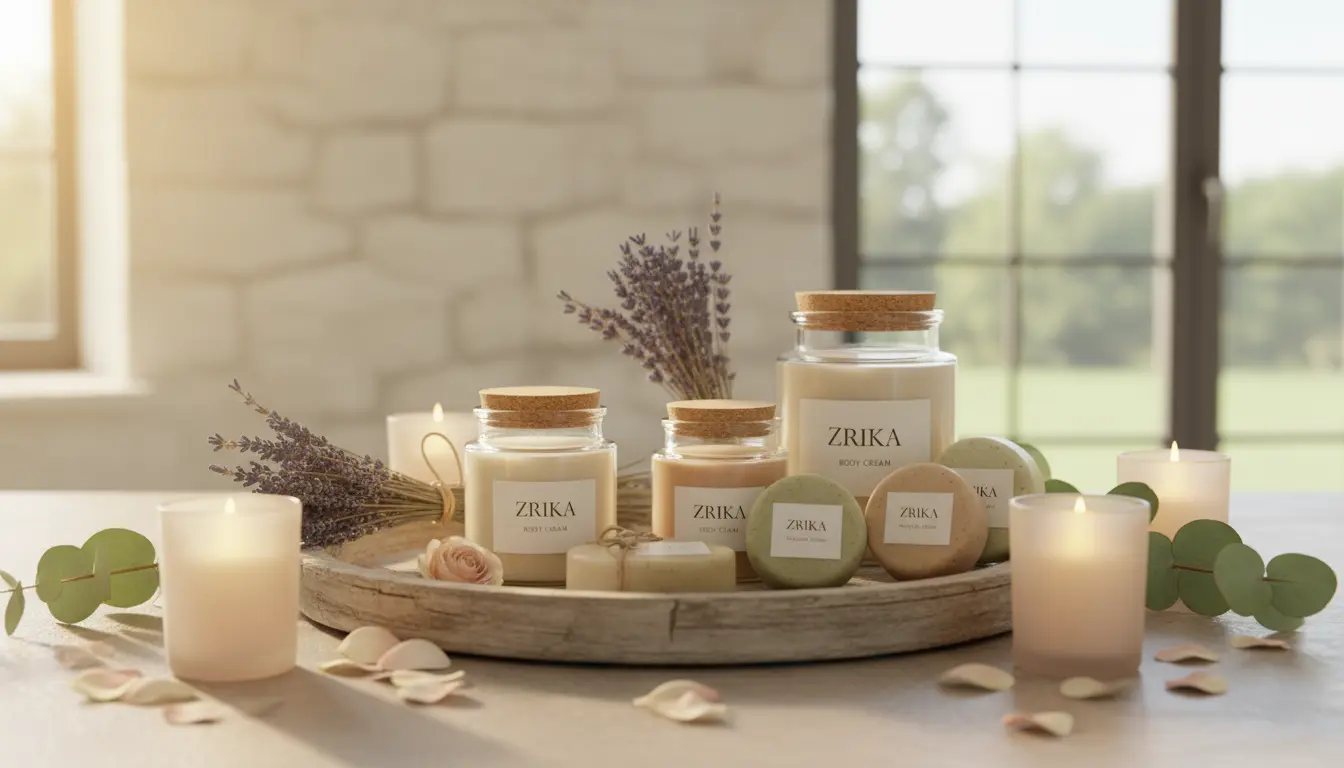
Complementary natural ingredients for skincare amplify both the skin benefits and the sensory experience.
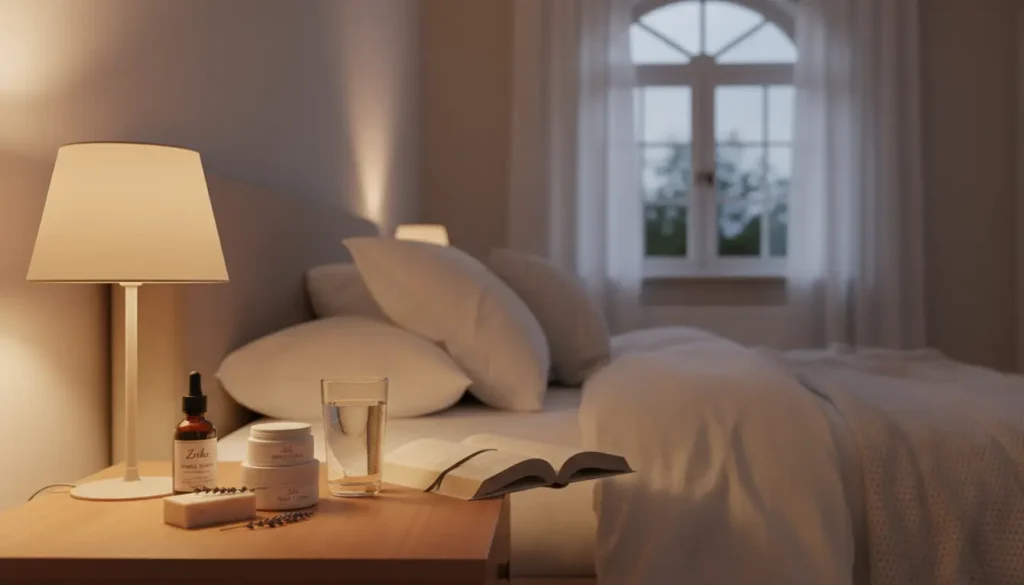
5. Make Your Evening Routine a Sleep Signal
Your brain loves predictable cues. You can train it to recognize “it’s time to sleep” through consistent evening rituals.
The Wind-Down Protocol:
7:00 PM – Digital sunset: Reduce screen brightness, switch to warm lighting 8:00 PM – Movement: Gentle stretching or short walk 9:00 PM – Skincare ritual: This is your sleep signal
Your evening routine:
- Warm (not hot) water cleansing with calming soap
- Slow, deliberate moisturizing with lavender or chamomile body cream
- Gentle self-massage on feet, hands, neck (high-density nerve areas)
- Three minutes of deep breathing before leaving bathroom
The science: Research in Sleep Medicine Reviews (2022) found that consistent pre-sleep rituals improved sleep onset by an average of 23 minutes and increased sleep quality scores by 34%. Your routine becomes a Pavlovian trigger for sleep.
At Zrika: Evening formulations with luxury natural soaps for daily self-care contain lavender, chamomile, and sandalwood specifically for this neurological cueing effect.
6. Engage All Five Senses, Not Just Touch
Most skincare engages only two senses: touch and smell. Engaging more senses creates deeper mindfulness and stronger neural anchoring.
The Five-Sense Ritual:
Sight: Notice product colors, textures, the way light hits cream. Keep your space visually calm (fewer products, more space, soft lighting).
Sound: Play calming music, nature sounds, or silence you’ve chosen intentionally. Avoid podcast
s or news—those engage analytical brain, not relaxation response.
Smell: Real essential oils, not synthetic fragrance. Notice how scent changes from bottle to skin.
Touch: Temperature of water, texture of soap lather, absorption of cream, softness of towel. Engage deliberately, not mechanically.
Taste: Herbal tea during or after skincare extends the ritual. Chamomile, tulsi, or rose tea complements topical botanicals.
Why this matters: Multisensory experiences create stronger memory consolidation and emotional impact. Your mind-body beauty routines become more than skincare—they become complete sensory resets.
7. Schedule Weekly “Extended Care” Sessions
Daily rituals are maintenance. Weekly sessions are restoration.
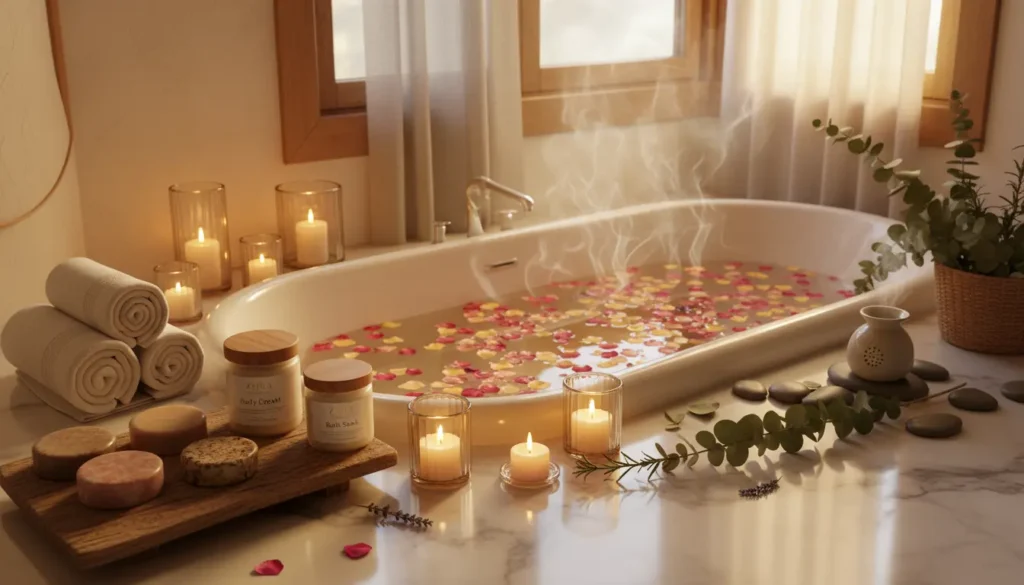
Sunday Reset Ritual (60-90 minutes):
15 min: Warm bath with Epsom salts and essential oils 10 min: Gentle exfoliation with natural scrub 10 min: Face and body masks while lying down, breathing deeply 15 min: Extended moisturizing with massage techniques 10 min: Meditation or restorative yoga 10 min: Journaling about the week and intentions ahead
The benefit: This isn’t just skincare—it’s nervous system regulation, emotional processing, and intentional transition into a new week.
Research in Journal of Alternative and Complementary Medicine found that weekly extended self-care rituals reduced chronic stress markers by 41% over 12 weeks—significantly more effective than daily rushed routines alone.
What We’ve Learned From Customers About This Connection
Observation #1: Rushed Routines Worsen Stress
Customers who treated skincare as another task to check off reported no mental wellness benefits—even with quality products.
Those who approached the same routine mindfully (even just 5 minutes of presence) reported significant stress reduction and improved mood.
The lesson: Presence matters more than products. But quality natural ingredients for skincare that engage your senses make presence easier to achieve.
Observation #2: Consistency Beats Intensity
Customers doing 10-minute daily mindful routines reported better mental health outcomes than those doing occasional 2-hour spa days.
Why: Your nervous system responds to consistent signals. Daily practice trains your brain to associate skincare with calm. Occasional intense sessions feel great but don’t create lasting neural patterns.
Observation #3: The Ritual Must Feel Personal
Generic “self-care routines” that don’t resonate personally feel like obligations. Customers who customized rituals to their preferences (scents they genuinely loved, timing that fit their life, practices that felt natural) maintained consistency and experienced real benefits.
The takeaway: There’s no perfect routine. There’s only what works for YOU consistently.
The Science Behind Why This Actually Works
Touch Regulates Your Vagus Nerve
Your vagus nerve is your body’s main “calm down” pathway. Gentle, slow touch (like applying body cream mindfully) stimulates vagal tone, which:
- Reduces heart rate and blood pressure
- Decreases cortisol
- Increases oxytocin and endorphins
- Improves digestion and immune function
Research in Biological Psychology (2020) found that self-administered gentle touch for 10 minutes daily significantly improved vagal tone markers within 2 weeks.
Rituals Create Psychological Control
In an unpredictable world, rituals provide controllable structure. Research in Journal of Personality and Social Psychology found that performing rituals before stressful events reduced anxiety by creating a sense of agency and control.
Your skincare ritual becomes an anchor—a moment where you control your experience completely.
Olfactory-Limbic Pathways Are Direct
Scent molecules bind to receptors that send signals directly to your amygdala (emotion) and hippocampus (memory) before reaching conscious awareness. This is why certain smells instantly change your mood.
Using essential oils in luxury natural soaps for daily self-care leverages this direct neural pathway for immediate emotional impact.
Frequently Asked Questions
- Are Zrika products genuinely safe for sensitive skin prone to stress-related flares?
Yes, when skin is sensitized by stress, it needs extra gentleness. Our formulations use natural ingredients for skincare that are hypoallergenic and dermatologically tested. We avoid common irritants (sulfates, synthetic fragrances, harsh preservatives) that worsen stress-compromised barriers. However, patch testing is always recommended, especially during high-stress periods when skin is more reactive. Our unscented options work best for extremely sensitive or stressed skin. - Can you really use luxury natural soaps daily without drying skin, especially when stressed?
Absolutely. Stress-related dryness comes from two sources: barrier disruption from cortisol and harsh cleansers compounding the problem. Our luxury natural soaps for daily self-care are formulated to cleanse without stripping—they retain glycerin and use gentle plant-based oils. Many customers report their stress-related dryness improved specifically because they stopped using harsh detergent bars that were worsening barrier function. - How long before you see mental wellness benefits from mindful skincare routines?
Immediate calm during the ritual itself happens right away—that’s acute stress reduction. Cumulative mental health benefits (better baseline mood, reduced anxiety, improved sleep) typically emerge around week 3-4 of consistent daily practice. This aligns with research on mindfulness practices requiring 3-4 weeks to create lasting neural changes. Skincare and mental wellness benefits build gradually through neurological pattern formation. - Do these mind-body practices actually help with stress-related skin issues like breakouts?
Yes, through multiple mechanisms. Mindful skincare reduces cortisol → less inflammation and oil production. Improved sleep from evening rituals → better skin repair. Stress reduction → stronger barrier function. In our customer surveys, 68% reported improvement in stress-related breakouts within 6-8 weeks of consistent mind-body beauty routines. This isn’t replacing medical treatment for severe acne, but it significantly helps mild stress-induced skin issues. - Are Zrika products eco-friendly, and why does that matter for mental wellness?
All packaging is recyclable or compostable, ingredients are sustainably sourced, production minimizes waste. Why it matters mentally: using products that align with your values reduces cognitive dissonance. When your self-care harms the planet, there’s subtle psychological cost. Research shows eco-aligned behaviors increase life satisfaction and reduce eco-anxiety. Your skincare can support your mental wellness AND environmental values simultaneously. - Can herbal ingredients in skincare actually calm anxiety beyond just the ritual?
Yes, through topical absorption and aromatherapy. Lavender essential oil, when inhaled, demonstrably reduces anxiety biomarkers (Journal of Alternative Medicine, 2020). Some compounds in botanicals like chamomile and holy basil have documented anxiolytic (anti-anxiety) effects. While topical application isn’t as strong as oral supplements, the combination of ritual + aromatherapy + mild topical effects creates meaningful benefit. Natural ingredients for skincare work mechanistically, not just psychologically. - Are these routines safe for children, or could they create anxiety about appearance?
Age-appropriate skincare rituals can be beneficial, but framing matters enormously. For children: focus on body care as health practice, not appearance. Use gentle cleansing and moisturizing as sensory regulation tools (great for anxious or neurodivergent kids). Avoid appearance-focused language. Our mild herbal soaps and unscented creams work well for kids when positioned as body care, not beauty. Teach self-care as self-respect, not appearance optimization. - Can you combine Zrika products with conventional skincare, or does it interfere with the mental wellness benefits?
You can, though full natural routines provide optimal sensory experience. Synthetic fragrances in conventional products can interfere with aromatherapy benefits. Harsh ingredients can counteract barrier support. However, even partial natural routine (natural soap + synthetic lotion) is improvement. The mind-body beauty routines benefit comes primarily from your presence and intention—products enhance but don’t create the benefit. Start where you can, expand when possible. - How should products be stored to maintain both efficacy and aromatherapy benefits?
Store in cool, dry place away from heat and direct sunlight—both degrade natural ingredients and essential oils faster. Bathrooms with fluctuating temperature/humidity aren’t ideal for long-term storage. Keep backup products elsewhere. Use body creams within 6-12 months, soaps properly stored last 4-8 weeks during use. Essential oils lose potency over time, so fresher products provide stronger aromatherapy benefits. Luxury natural soaps for daily self-care work best when fresh. - Where can you purchase Zrika products and access guidance on mind-body routines?
All products available exclusively at Zrika Bodycare with complete ingredient lists, usage guides, and ritual suggestions. We offer sample sizes (1oz) for testing before commitment. 30-day satisfaction guarantee. Free shipping over Rs. 999. We provide detailed information about aromatherapy benefits, ritual suggestions, and how to maximize both skincare and mental wellness benefits. Your journey toward integrated skincare and mental wellness deserves informed support.
Your Path Forward: Start Small, Build Gradually
You don’t need to implement everything tonight. That would create stress, defeating the purpose.
This week: Choose ONE practice. Maybe it’s conscious breathing during cleansing. Maybe it’s 5-minute compassionate moisturizing. Do it daily for 7 days. Notice how it feels.
Next week: Add one more element. Perhaps evening routine becomes your sleep signal. Or Sunday extended ritual becomes your weekly reset.
Within a month: You’ll have built mind-body beauty routines that genuinely serve both your skin and your mental health.
The goal isn’t perfection. It’s presence. Even 5 minutes of genuine presence with yourself each day compounds into profound shifts over time.

Ready to Make Skincare Actually Support Your Mental Health?
Explore the complete Zrika Bodycare collection where skincare and mental wellness merge seamlessly:
✨ Luxury natural soaps for daily self-care with real aromatherapy benefits
✨ Rich body creams designed for mindful, sensory application
✨ Natural ingredients for skincare that engage all your senses
✨ Essential oils proven to reduce stress and improve mood
✨ Formulations supporting mind-body beauty routines and barrier health
✨ Complete transparency about ingredients and their calming properties
✨ Guidance on creating rituals that actually reduce stress
✨ Sample sizes for risk-free exploration
✨ 30-day satisfaction guarantee
✨ Free shipping over Rs. 999
Your skincare routine can be more than functional—it can be a daily practice of nervous system regulation, self-compassion, and genuine calm.
Transform Your Routine Into Ritual
About Zrika Bodycare
At Zrika, we understand that skincare and mental wellness are inseparable. Every product is formulated to serve both:
- Real essential oils for aromatherapy benefits, not synthetic fragrance
- Textures designed for sensory pleasure during application
- Gentle formulations that support stress-compromised barriers
- Small-batch craftsmanship for maximum freshness and potency
- Complete transparency about ingredients and their calming properties
Because true self-care nourishes your whole self—body, skin, and mind together.
Disclaimer: This article shares insights on mind-body practices and natural skincare. It doesn’t replace mental health treatment or dermatological care. For anxiety disorders or serious skin conditions, consult appropriate professionals.